
To jest treść Archiwalna. Sprawdź nasze najnowsze Insights, aby poznać aktualne informacje, ekspertyzy i trendy.
Create choice and guide the customer
The insurance industry is undergoing obvious changes, and we’re all trying to predict them. Historically, one of the best methods for prediction has been drawing parallels, especially when the things we compare seem to have nothing in common on the surface but end up revealing interesting analogies. A perfect example is comparing insurance to the music industry – on the surface, they have nothing in common, but there are some lessons insurers can take from it.
Insurers are very much like recording studios from the 80s and 90s. Compare insurance to a recording studio such as Universal.

Music is distributed in the form of albums. And it is the studio that decides which songs go on which album. If you, as a customer, want to listen to a specific song, you need to buy the whole album compiled by the studio. It resembles the creation of insurance products – we put several risks together, and customers who need only some of them still have to buy the whole product.
Then iTunes came along – a step in the right direction.
Customers could now select and buy each song individually. iTunes resembles modern InsurTechs – straightforward products and simplicity of the sales process over insurance know-how. But for some reason, this model was not the final form of evolution in the music industry. The reason is called “choice overload”.
In 2000, psychologists from Columbia and Stanford Universities published a study about jams. On a regular day at a local food market, people would find a display table with 24 different kinds of jam. On another day, at the same food market, people were given only 6 different types of jam. Obviously, the first table generated much more customer attention. But the second generated more sales. In fact, it generated 10 times more.
Choice overload makes customers hover around more but purchase less.
Choice paralyses the consumer. This issue has already been solved by the music industry. Specifically, by Spotify.

Spotify not only offers each song individually but also makes it possible to create playlists, with a new automatically recommended playlist every week. In fact, three different Machine Learning mechanisms are applied so that each Spotify user gets a fully personalised playlist every week. This model, let’s call it “Guided freedom of choice”, is not only interesting from a technological point of view but also leads to strong business results.
For the music industry, digital seemed like a niche at first, just as it did for insurance at the time. But look what happened.
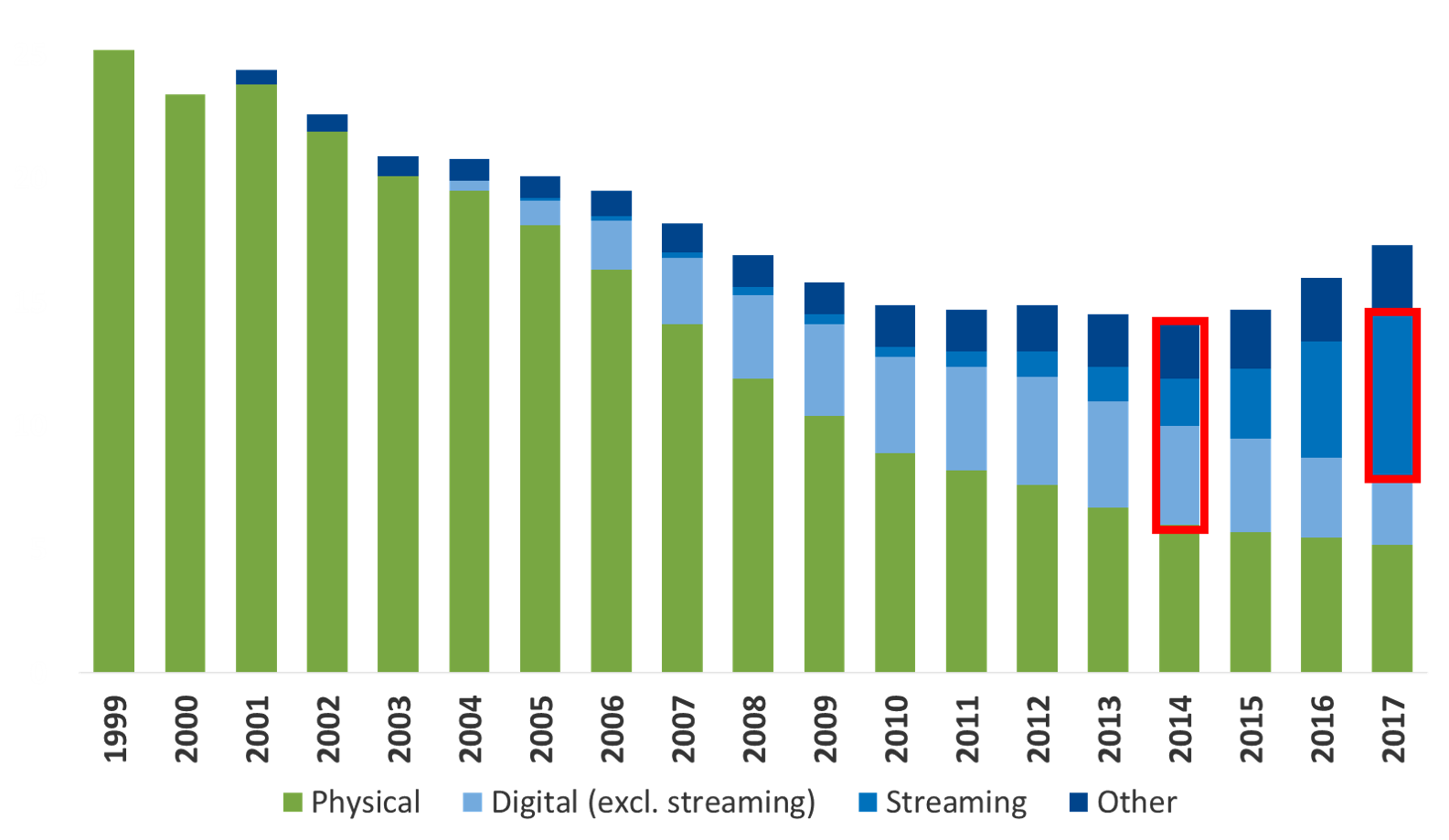
In 2014, digital distribution caught up with physical distribution, and already in 2017 streaming itself became the biggest channel.
“Once these changes gained pace, they became incredibly fast.”
A similar trend is unfolding in insurance. There are, of course, many differences, most notably strict regulations, which mean that the digital revolution in our industry is happening more slowly and will have to be different from the journey from Universal to Spotify. Nevertheless, it is an inevitable direction.
Discussing these topics with many insurers across different markets, we identified a pattern of 4 distinct digitalisation types and came to the conclusion that, as an industry, we should be able to serve digital customers digitally and traditional customers traditionally – however they wish, without forgetting the underlying principles of our industry.