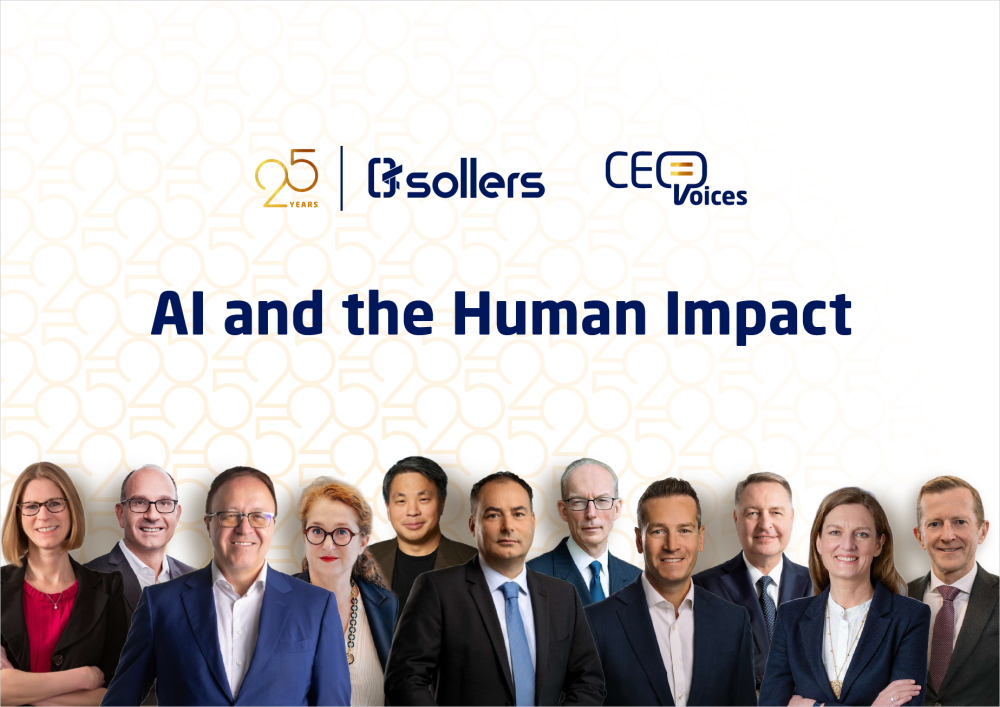
Insurance leaders identify Artificial Intelligence as the most influential technology shaping the industry today, ahead of cloud, core systems, and the Internet of Things, reveals a new Sollers Report based on insights from 11 CEOs of leading insurance companies worldwide. AI is redefining insurance in operations as well as human relations, emphasizes the report.
Artificial Intelligence is seen by insurance CEOs as the most influential – and potentially disruptive – technology, reveals the new Sollers Report “AI and the Human Impact”. AI changes insurance not just operationally, but fundamentally in how insurers work with people. While many CEOs acknowledge the hype surrounding AI, they emphasize its real and growing impact across the entire insurance value chain – from underwriting and pricing to claims handling and customer service.
The report is based on the CEO Voices interview series that reflects on the technological evolution of insurance over the past quarter-century and looks ahead to the next 25 years. CEO Voices include interviews of insurance CEOs from Germany, France, UK, USA, Australia, Canada and Slovenia.
“AI is already improving efficiency, particularly in processing unstructured data,” emphasizes Sollers president and co-founder Michał Trochimczuk. “Cost control will be the key to competitiveness. This means investing in automation, simplified standard architectures, modern rating systems and intelligent risk selection.”
A central theme of the report – and a key differentiator from purely technical discussions – is the human impact of AI. CEOs repeatedly stress that AI should enhance, not erode, empathy, personalization, and face-to-face interaction.
“Several CEOs highlight workforce transformation as one of the most pressing challenges ahead,” says Marcin Pluta, President and co-founder of Sollers. “Our interviewees reject the notion that AI inevitably destroys jobs. Instead, roles are shifting toward more technological, analytical, and strategic responsibilities.”
The report makes clear that AI is not confined to specific departments. AI and in particular generative AI will become embedded in every aspect of insurance – from pricing engines and product design to claims automation and customer interaction. Risk management is among the most prominent areas that evolve. Leaders note that technology has transformed how insurers quantify, assess, and manage risk – while still relying on human insight to interpret and act on data-driven results.
With the CEO Voices Report, Sollers Consulting takes a deliberately balanced stance on AI – acknowledging both its transformative potential and the responsibility insurers have to integrate it thoughtfully. The report concludes that the future of insurance will be shaped not just by smarter systems, but by how effectively insurers align AI, people and purpose.
For the report Sollers conducted interviews with Prof. Dr. Frank Walthes (CEO of VKB, Germany), Andrew Horton (CEO of QBE, Australia), Simon Wilson (CEO of Markel Insurance, USA), Jean-Daniel Laffely (CEO of La Vaudoise, Switzerland), Ken Norgrove (CEO of Intact UK&I), Marcus Ryu (Battery Ventures, USA), Isabelle Le Bot (CEO of La France Mutualiste, France), Agnès Paquin (CEO of CNP Assurances, France), Andrej Slapar (CEO of Triglav, Slovenia), Dr. Jürg Schiltknecht (CEO of Helvetia Germany) and Brenda Gibson (CEO of Red River Mutual, Canada). The interviews were conducted by Michał Trochimczuk, Marcin Pluta, and Sollers Partner Martin Seibold.
The full report can be accessed here: AI and the Human Impact