
Apr 14, 2026
AI in Insurance, Claims, Process Automation, Underwriting

Touchless Automation and HITL - when to use Deep Learning or Large Language Models, and when to shift to AI Agents in Business Transformation.
What is this article about?
What inspired me to write this article were discussions with our clients and my team members, who were often focused on using Large Language Models (LLMs) for almost every use case, in contrast to classical Deep Learning (DL) models. LLMs are powerful and easy to use, but it is worth examining their limitations and understanding where it makes sense to apply them — or not — within an overall AI architecture.
This article describes an approach to processes such as underwriting or claims handling, where extracting structured data — an essential part of Intelligent Document Processing (IDP) — is key to automation. It explores the business perspective on touchless processing and Human-in-the-Loop (HITL), and how these requirements influence the selection of AI models and, more broadly, the design of AI architectures.
Moreover, AI tools are sometimes broadly and incorrectly associated with an AI-agentic approach. This article therefore also looks at the relationship between the two and discusses when an agentic approach is actually needed in the context of IDP.
IDP is core to automating underwriting and claims handling
First, let’s clarify why automating document data extraction matters at all in the insurance context. Here, by automation we mean the full spectrum - from fully touchless processing to strong human augmentation.
The Sollers AI Report, released in 2025 and based on in-depth interviews with insurers, shows that IDP is one of the most important trends in AI-driven automation in insurance. However, at present, there is more progress in claims handling than in underwriting.
Beyond the report, at Sollers we have developed a vision for end-to-end automation of the underwriting process. In this vision, smart submission — currently the main focus across the market — is only the starting point.
BUSINESS PERSPECTIVE
Touchless automation requires control over AI correctness
Although it is not achievable in every process scenario, the ultimate automation objective is touchless processing, without the need to involve a human (employee) — for example, from claim notification through to claim payment. However, for certain data fields that are critical to business outcomes, there must be control over the correctness of AI recognition.
Of course, organizations can estimate error rates and treat incorrect claim payments as part of the solution cost. However, if incorrect recognitions can be filtered out and routed to Human-in-the-Loop (HITL), the overall business case for such an approach can be significantly stronger.Users need guidance to be effective in HITL
The worst-case HITL scenario involves asking a user to verify numerous data fields extracted by AI, while providing only a long PDF document with no guidance on where to look. In this case, the user must spend significant time searching and verifying, and their attention becomes fragmented — ultimately reducing verification accuracy.
Whether HITL is used as an exception-handling mechanism for touchless automation or as a standard workflow where every AI recognition is reviewed to increase productivity and/or quality, the user requirements for effective verification of AI output are largely the same.
Guide users on which data values to verify
Users should be given a clear, high-level overview of the case status and know exactly what actions are required from them. They should not be expected to spend time verifying unnecessary information. Instead, their attention should be focused on validating data fields that are critical to business outcomes, such as risk assessment, policy pricing, or claim payouts.
Guide users to the source data location
When a user needs to verify an AI-generated value, the process should be fast and intuitive. The user should be shown the relevant document fragment with the extracted data clearly highlighted, allowing verification to take seconds rather than minutes otherwise spent searching through lengthy documents.
AI MODEL DEFINITIONS
All major cloud providers offer both types of AI models and tools used in Intelligent Document Processing (IDP): classical Deep Learning (DL) models and Large Language Models (LLMs). Let’s start with some basic definitions.
DLs: Classical Deep Learning models
Classical Deep Learning models are neural networks trained for a specific, well-defined task, such as image classification, speech recognition, or document data extraction. They typically learn from labelled datasets, have fixed inputs and outputs, and, once trained, their behaviour does not change unless the model is retrained..
LLMs: Large Language Models
A Large Language Model is a single, very large Deep Learning model — typically based on the transformer architecture — composed of many stacked neural network layers and billions of parameters. LLMs are trained on massive volumes of text to learn the general structure and patterns of language.
Unlike classical DL models that are optimized for a single task, LLMs can generate, understand, summarize, and reason over text across many tasks using the same underlying model. They can be adapted to new tasks through prompting or fine-tuning, rather than full retraining.DLs vs. LLMs UNVEILED
LLMs are easier to configure
An LLM can be configured using only a prompt, without the need for a training dataset. If the required data structure is complex, the prompt itself may also be complex — but this is still significantly easier than training a classical DL model. DL models typically require hundreds of documents and extensive labelling, such as identifying keywords and assigning correct labels. On average, 50–200 documents are needed per single label.
That said, modern IDP solutions increasingly use LLMs to augment and improve the productivity of users performing the labelling required for DL models. It is also worth noting that LLMs can be fine-tuned (or “up-trained”) to improve accuracy for specific use cases.Using DL models may be cheaper than LLMs
For high-volume, well-defined document extraction tasks, task-specific DL models generally require less compute per inference than LLMs. As a result, they can be more cost-effective when deployed at scale.
However, factors such as licensing, maintenance, and flexibility may make LLM-based solutions more economical for low-volume or highly variable use cases.DL models allow effective control of recognition correctness
Mature DL models typically provide out-of-the-box confidence level (CL) metrics for each extracted data field and label. These metrics enable the use of statistical methods to filter out uncertain recognitions and route them to manual (human) handling.
LLMs, in contrast, do not provide such confidence levels out of the box. While it is possible to ask an LLM to estimate confidence, the general-purpose nature of these models means such values often do not reliably fulfill the role of true confidence metrics. Other techniques exist to control recognition correctness, but they (a) are often not fully effective and (b) require additional effort to develop and maintain.DL models provide references to the source
A similar comparison applies to source traceability. Mature DL models usually provide out-of-the-box references to the source document, including coordinates of the extracted data. This enables fast and accurate verification.
LLMs do not inherently provide this information. Although various techniques can be used to approximate source references, they are not always reliable and typically require additional implementation and maintenance effort.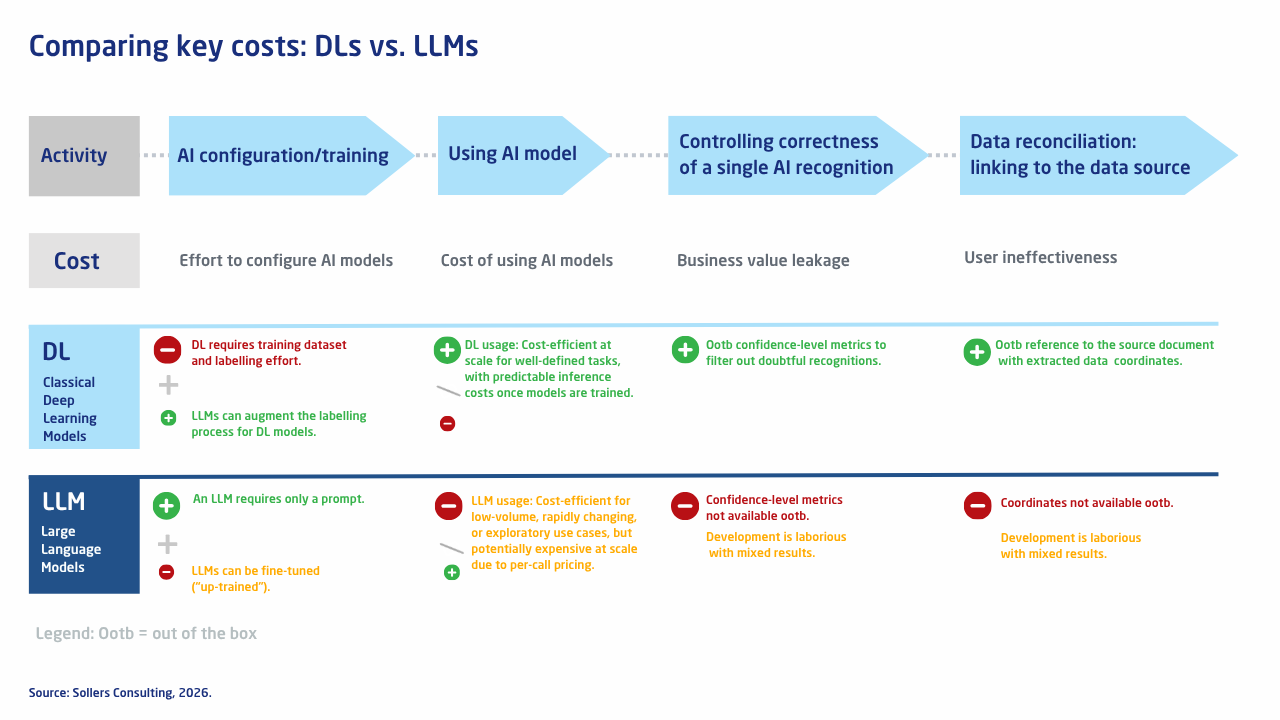
IDP IMPLEMENTATION
Choosing DLs or LLMs for core data extraction
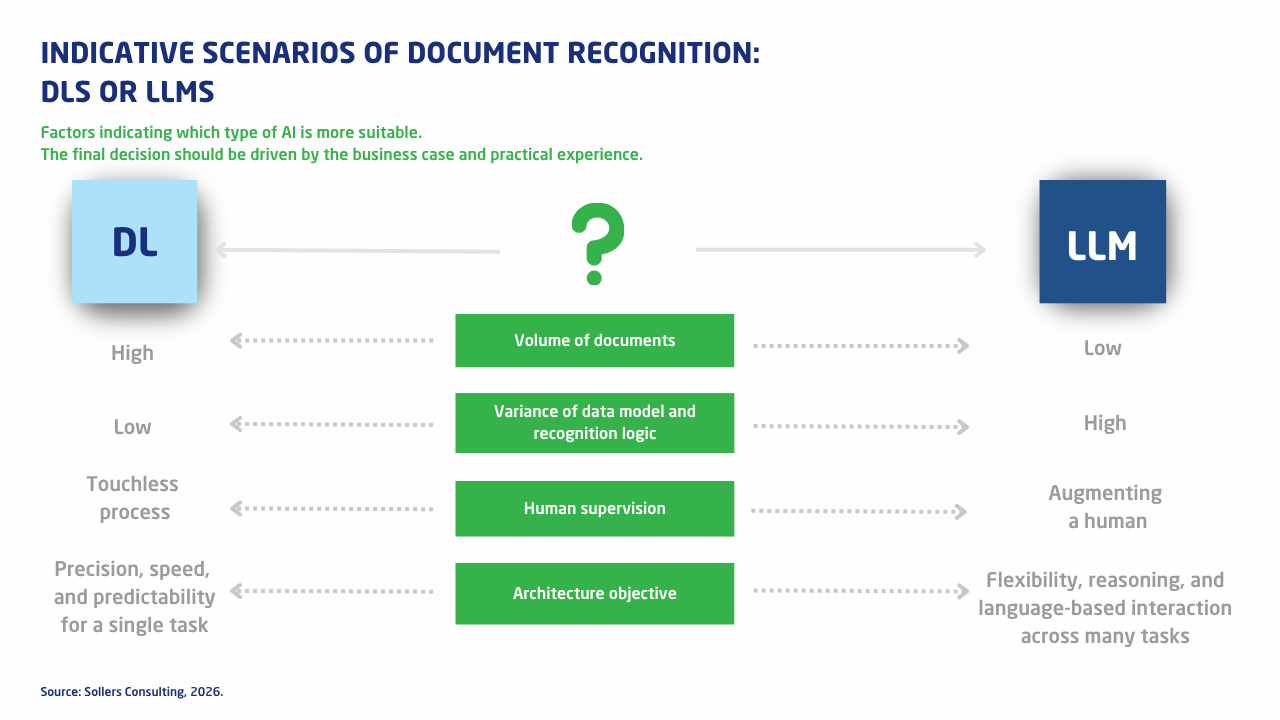
When starting a Proof of Concept (PoC), LLMs are usually the simplest choice. They are easy to use, allow teams to see initial results quickly, and often deliver very promising outcomes. However, as shown so far, when a more holistic view of the target process is taken, the picture becomes more complex.
The diagram illustrates various factors indicating which type of AI—DL or LLM—tends to be more suitable for a given scenario. Ultimately, the final decision should be driven by a holistic business case. At the beginning, an organization may not yet have sufficient knowledge or data to fully inform that business case. This understanding develops over time through practical experience — by experimenting, testing, implementing, and inevitably learning from mistakes.
Data extraction is only part of the IDP story
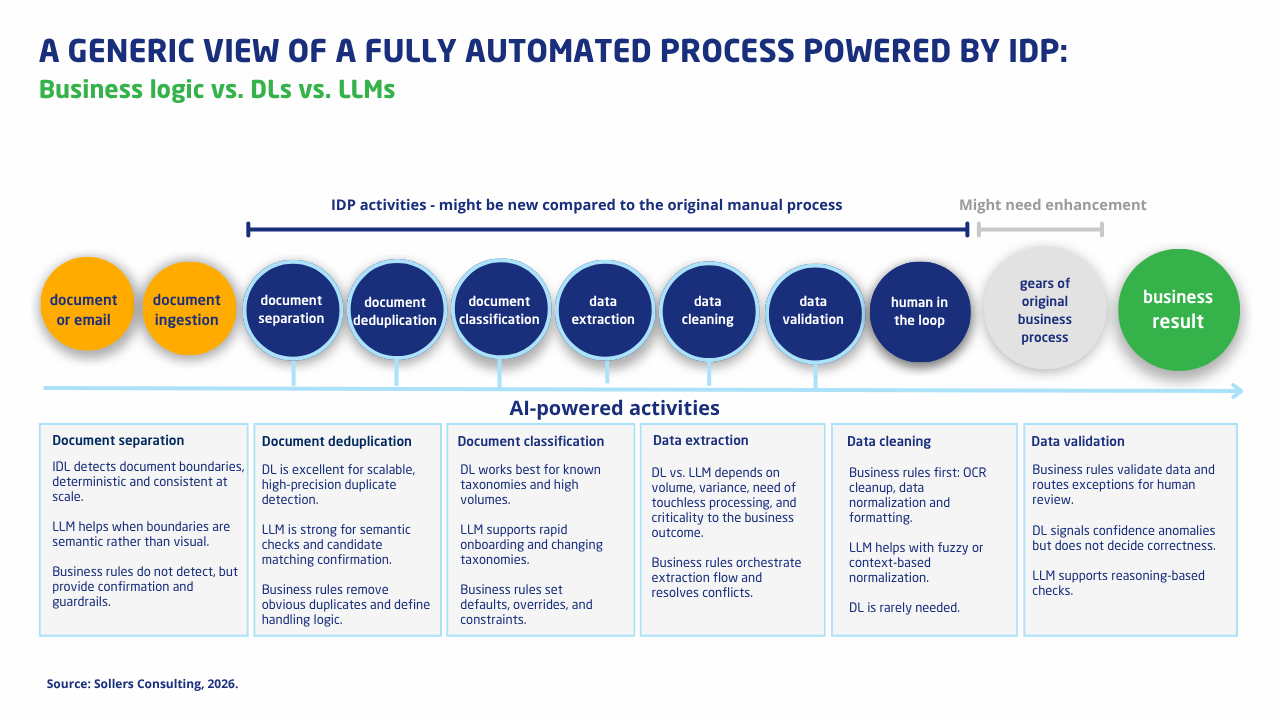
Extracting data from documents is only one part of the overall IDP process. Although it is the most common focus for PoCs, a target end-to-end process typically requires additional activities that can also be automated using AI, such as document separation, deduplication, classification, data extraction, cleaning, and validation.
To provide a complete perspective, the comparison must also include business rules (or business logic in a broader sense), which play a critical role alongside DL models and LLMs. To give an initial overview, the diagram presents typical examples of how business rules, DLs, and LLMs can be applied across the full IDP lifecycle.
Each of these components plays a different role and has a different level of importance depending on the task. Business rules ensure determinism, control, and compliance; classical DL models deliver scalable and accurate perception and extraction; and LLMs provide semantic understanding and adaptability in ambiguous scenarios. The most mature IDP platforms are hybrid: together, these components enable high levels of automation while maintaining reliability and governance in enterprise IDP processes.
AI-AGENTS
Conceptually, the AI-agent is an additional layer
At this point in the article, readers may ask whether an AI-agentic approach changes what we have already learned about IDP processes and the selection of AI models. The answer is both yes and no.
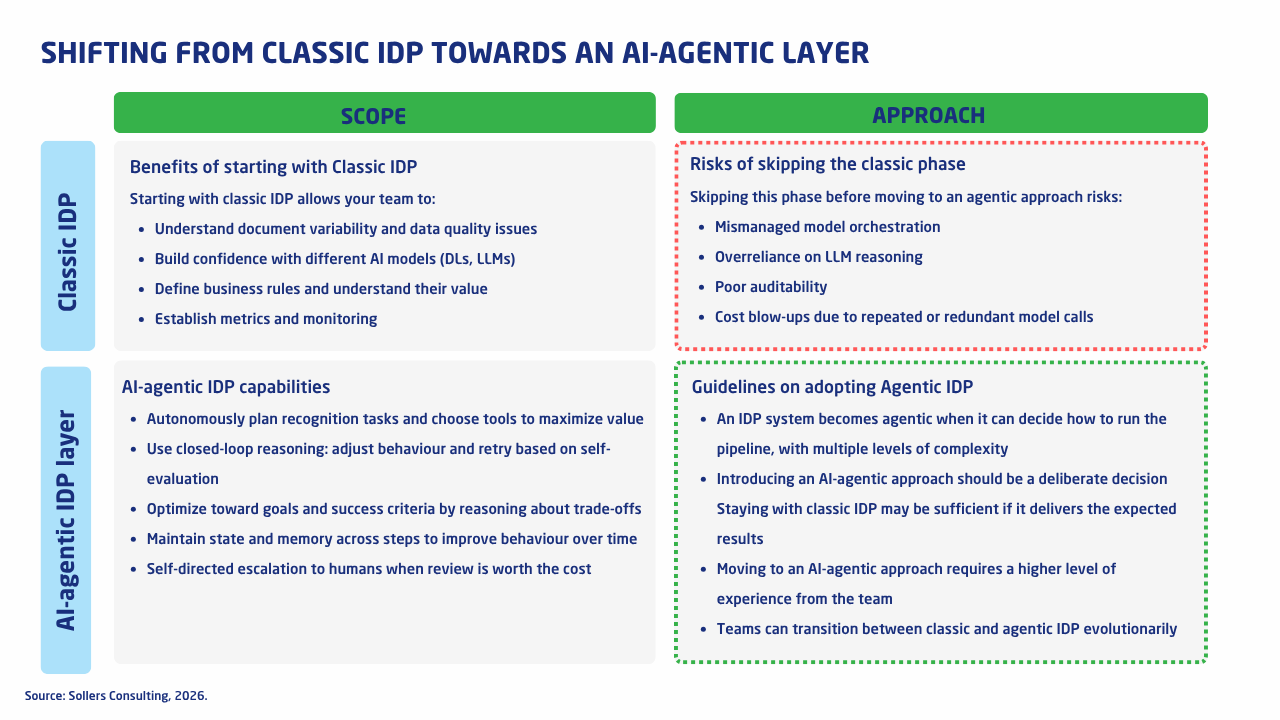
You can think of IDP as consisting of two layers (as shown in the diagram): a classical IDP layer and an AI-agentic IDP layer. Yes, the agentic layer introduces additional complexity into the system design. No, it does not eliminate the need to understand and implement classical IDP first. An agentic approach is primarily about orchestrating, reusing, and managing the classical IDP pipeline more effectively.
For this reason, we recommend introducing the agentic approach gradually. Organizations should start with a classical IDP implementation and, once teams have learned how to train, fine-tune, and stabilize the AI models, extend the solution with agentic capabilities. This ensures that the agentic system is built on solid foundations, minimizes the risk of failure, and gives the team time to learn gradually rather than being overwhelmed by design complexity from the very start.
Introduce an AI-agentic approach only for complex scenarios
An IDP system becomes agentic when it can decide how to process a document based on goals, context, and intermediate outcomes, rather than strictly following a fixed pipeline.
Introducing an AI-agentic approach should be a deliberate decision, driven by the need to optimize the overall cost–effectiveness of the solution. In many cases, a classical IDP approach may already deliver the expected results. Most of the value in IDP comes from good models, well-designed business rules, and meaningful metrics. Agency amplifies these components — it does not replace them.
An AI-agentic approach should be considered only when one or more of the following conditions apply:
- Document variability is high, and a rigid pipeline is ineffective
- Multiple viable tools exist, and their performance varies (e.g., by document type)
- Human-in-the-loop costs are high or increasing
- Validation fails for many different reasons
- Business risk and cost vary significantly by document or by data field
BUSINESS TRANSFORMATION
Beyond AI: end-to-end processes and target architecture
So far, we have discussed IDP, AI models, and AI agents. However, successful implementation requires much more than selecting the right AI technologies. It also requires a clear understanding of how to automate core business processes (such as underwriting or claims handling) end to end, as well as defining the target architecture and the tools needed for workflow orchestration, business logic, HITL user interfaces, IDP, and AI-agentic platforms.
The lack-of-knowledge trap
Effective implementation requires solid tools, but making the right architectural choices for AI-driven automation requires experience-based knowledge of what it truly takes to automate processes with AI. The challenge is that this knowledge is typically gained only through hands-on implementation.
The role of an advisor: faster implementations and stronger internal teams
Engaging experienced experts or consultancies can accelerate implementation by bringing in proven knowledge and best practices. However, it is equally important to use this opportunity to help internal implementation teams learn and mature quickly. Insurers ultimately need this internal expertise to make sound architectural and transformation decisions.
For organizations that are new to AI, designing a mature, company-wide transformation from the outset is extremely difficult without prior experience.
A way forward: an evolutionary, planned, phased learning-and-implementation approach
Begin by building a high-level vision of the required target architecture and its components. Start implementation with simpler tools (for example, cloud-provider AI services), and plan to make more informed decisions about advanced components — such as IDP platforms or AI-agentic platforms — once the organization has gained sufficient practical experience.
With a long-term vision in place, adopt a phased approach in which continuous learning is combined with gradual development of architecture and AI-driven business logic. Insights gained from implementation projects and strategic planning should reinforce each other — helping to identify areas with the greatest automation potential and to introduce increasingly advanced toolsets, phase by phase.
Author of the article
 Piotr Kondratowicz - Business Architect
Technology & Market Insights

Sollers Expertise
Agentic AI in Insurance: Achievements, Challenges, and the Road to Scale

Sollers Expertise
GoQu’s Code Quality Data Reveals: Guidewire Upgrades Don’t Become Expensive Overnight