
This is Archived content. Explore our latest Insights for recent updates and perspectives.
In times of rapidly changing technological environments and customer preferences, companies face unprecedented challenges. New digital business opportunities are emerging, and competition is taking on a new dimension. Boundaries between industries and sectors are blurring. As business strategies and models change, new solutions are needed.
These days, doing things the right way is not enough to gain and maintain a competitive advantage. Traditional approaches guarantee neither success nor survival. A broader perspective and a conscious strategy are needed. Companies need to understand the social, technological and economic conditions that influence reality and drive customer needs.
To address and create these needs, companies are expected to follow market trends while also helping to shape them. Strategic thinking plays an important role here. It enables companies to recognise and analyse changes in their environment early and respond with innovative solutions.
Companies and industries are currently facing unprecedented market changes. Product life cycles and traditional value chains are becoming shorter due to decreasing entry barriers and the emergence of new players and start-ups. Similar disruptions are occurring in supply chains. Disintermediation, the removal of intermediaries, as well as forward and backward integration, can increasingly be observed.
Coopetition is also emerging as a new dimension of competition and cooperation. Companies can succeed by establishing and developing mutually beneficial long-term relationships with organisations from different markets, sectors and environments. They build new structures that combine suppliers, distributors, partners and other stakeholders that may sometimes compete with one another. Such structures are described as business ecosystems.
Definition and etymology
A business ecosystem is a “network of different organisations involved in the delivery of a specific product or service through both competition and cooperation.” The concept assumes that each member of an ecosystem affects and is affected by others, creating a constantly evolving relationship. Each member has to remain flexible and adaptable in order to survive.
The logic of the system is analogous to biological ecosystems. The parallel was first introduced in 1993 by business strategist James Moore. In his Harvard Business Review article Predators and Prey: A New Ecology of Competition, he compared companies competing in an increasingly interconnected world of commerce to communities of organisms adapting and evolving to survive.
The idea of a business ecosystem is therefore not new. One of the best-known business ecosystem evolution structures was proposed by James Moore in 1996 and consists of three stages:
- core business
- extended enterprise
- business ecosystem
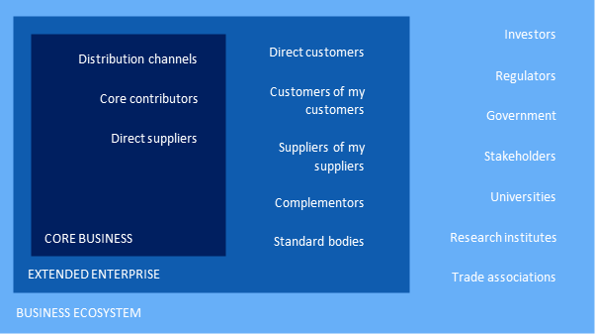
Based on: The Death of Competition: Leadership and Strategy in the Age of Business Ecosystems (Moore, 1996).
As in a natural ecosystem, organisations involved in a business ecosystem have to compete for survival, adapt or go extinct. Moreover, organisations often participate not only in one industry but in many interconnected markets, sectors and industries.
The idea of cooperation is to co-evolve capabilities and roles, establish a common goal and align activities towards a shared direction set by the leading companies, which may change over time. One of the most important factors for all members is sharing a common vision and values, as this helps ensure benefits for all participating parties and supports sustainability.
Characteristics
A characteristic feature of a business ecosystem is the presence of high entry barriers. Every ecosystem is naturally surrounded by a kind of moat that protects it from the external environment and unwanted entrants. This mechanism protects the ecosystem’s internal knowledge, technology, know-how, patents, research resources and specific cooperation conditions.
A unique combination of these factors can leverage the potential of individual elements, create synergies and provide a competitive advantage. While duplicating a single product may be relatively easy, replicating an entire ecosystem can be challenging or even impossible.
Moreover, if a growing number of organisations increases the value of products or services, a network effect can emerge. On the other hand, building an ecosystem can diversify the overall risk of business activity. A heterogeneous group is less sensitive to external disruption and can remain more stable even under challenging market conditions.
Crossing industry boundaries and building customer loyalty
By crossing the boundaries of a single industry, ecosystems can create entirely new markets that combine products and services from diverse and sometimes distant sectors. The main objective of such broad cooperation is to provide customers with a holistic and unique user experience. This applies to the insurance sector as well.
Due to the rapid development of digital business, customers’ expectations have changed significantly. It is no longer only about satisfying a need but also about convenience, and companies must respond accordingly. Customers have access to an enormous range of comparable products. Competition is increasing, and customer loyalty can quickly disappear when a better offer enters the market.
This raises an obvious question: How can a company maintain and expand its customer base under such market conditions? According to research, innovation and effective management provide part of the answer. To win customers’ attention, interest and loyalty, companies need to provide unique or even revolutionary solutions and an exceptional user experience. When this approach is complemented by additional goods and services, it can create a highly desirable lock-in effect.
Based on data collection, advanced analytics, behavioural economics and valuable insights, companies that belong to an ecosystem can tailor their offerings more closely to customers’ expectations. Moreover, they can help create new customer needs.
From an insurer’s perspective, data can become a key success factor. It enables effective profiling, risk estimation and customer segmentation. Even though customers are often cautious about sharing personal data directly, data may be collected indirectly within an ecosystem.
New sources of data, their appropriate use and, of course, their protection are among the key challenges and opportunities for the new era of insurance. It is not only about going digital. It is about innovating and managing change, innovation and trends.
Customers do not expect offline products simply to be made available online. They demand new insurance products addressing areas such as cyber risk, commuting, travel, pets and health protection. Other benefits generated by ecosystems can include lower distribution costs and improved claims prevention.
Current state and possible future development
These are some of the key benefits of building, maintaining and developing a business ecosystem:
- Developing new forms of cooperation to minimise external risk and respond to social, economic and technological challenges.
- Improving knowledge transfer and creativity.
- Increasing innovation and reducing time-to-market.
- Reducing production costs through economies of scale and scope.
- Meeting complex customer needs more effectively, providing a unique customer journey and experience through extensive data collection and analysis, and creating tailored loyalty programmes.
Digital ecosystems can personalise products, improve customer experience and extend the boundaries of value creation in insurance. It is up to insurers to decide whether they will take advantage of this opportunity by forming or joining an ecosystem. Customers are open to change, markets are evolving, and this is the right time to be active and creative.
References
Moore, J.F. (1999), Predators and Prey: A New Ecology of Competition, Harvard Business Review 71(3), https://www.researchgate.net/publication/13172133_Predators_and_Prey_A_New_Ecology_of_Competition
Moore, J.F. (1996), The Death of Competition: Leadership and Strategy in the Age of Business Ecosystems, Harper Business.
Avramakis, E., Anchen, J., Raverkar, A. K. & Fitzgerald, C. (2019), Digital ecosystems: extending the boundaries of value creation in insurance, https://www.swissre.com/institute/research/topics-and-risk-dialogues/digital-and-technology/Digital-ecosystems.html
Lorenz, J. T., Deetjen, U., van Ouwerkerk, J. (2020), Ecosystems in insurance: The next frontier for enhancing productivity, https://www.mckinsey.com/industries/financial-services/our-insights/insurance-blog/ecosystems-in-insurance-the-next-frontier-for-enhancing-productivity
Hayes, A. (2019), Business Ecosystem, https://www.investopedia.com/terms/b/business-ecosystem.asp
Heikkilä, M., Kuivaniemi, L. (2012), Ecosystem Under Construction: An Action Research Study on Entrepreneurship in a Business Ecosystem, Technology Innovation Management Review, https://www.researchgate.net/publication/326312926_Ecosystem_Under_Construction_An_Action_Research_Study_on_Entrepreneurship_in_a_Business_Ecosystem
Hagel, J., Brown, J. S., Wooll, M., de Maar, A. (2015), Shorten the Value Chain: Transforming the Stages of Value Delivery, Deloitte University Press, https://www2.deloitte.com/content/dam/insights/us/articles/disruptive-strategy-value-chain-models/DUP_3057_Shorten-the-value-chain_v2.pdf